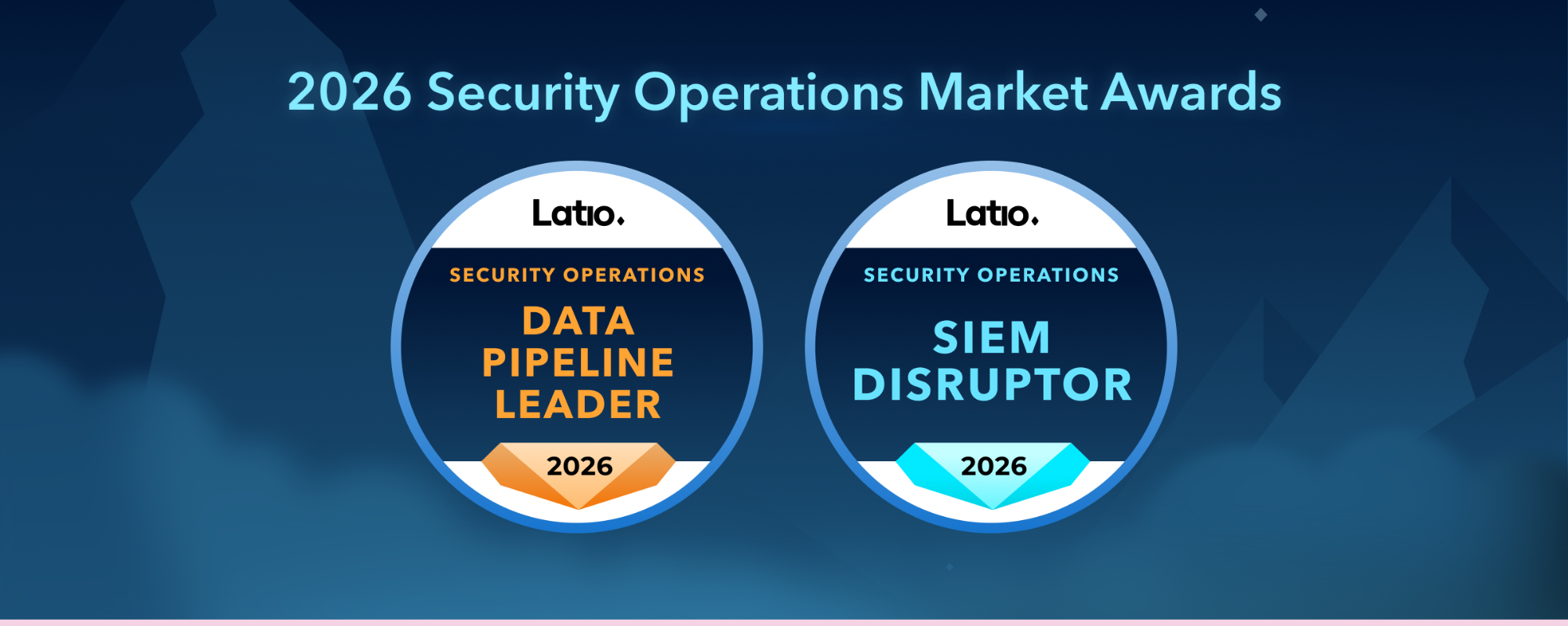

We're proud to share that Beacon has been recognized as both a Data Pipeline Leader and SIEM Disruptor in the 2026 Latio Security Operations Market Report, an independent study from Latio covering how security operations teams are buying, building, and modernizing their SOC programs right now.
Latio's methodology is worth explaining briefly, because it matters for how you interpret the recognition. They test products. They survey practitioners. Their research is grounded in actual usage patterns rather than vendor briefings and marketing decks. That context is why appearing across multiple sections of the report, across Data Pipelines, SIEM architecture, Federated Search, and Agentic Response, feels meaningful to us. It reflects the breadth of what we've built, not just a category checkbox.
What the report is actually saying about the market
The 2026 report lands at an interesting moment. The underlying architecture of the SOC is being rebuilt at the same time that the response layer is being automated, and those two developments are more connected than most teams realize.
On the SIEM side, Latio documents a clear shift away from monolithic, vendor-locked architectures toward more distributed models, where logs are routed across object storage, data lakes, and traditional SIEMs in parallel depending on cost and queryability needs. This isn't new as a concept, but the tooling to actually execute it has matured significantly in the past two years, and teams are starting to act on it. The report notes that 68% of respondents are unhappy with their current SIEM, but only 28% feel the migration cost is worth it. The gap between those two numbers is exactly where Beacon operates.
On the AI side, the findings are more nuanced than most vendor narratives suggest. 80% of security teams are choosing to build or run AI tooling in-house rather than purchase a dedicated AI SOC platform. The investment is real, but teams are approaching it carefully, as an operational enhancement layer rather than a wholesale replacement of existing infrastructure. The report's conclusion puts it plainly: no AI analyst automation can solve underlying data problems. Agents need fast, reliable, consistently structured data to reason properly. When that foundation isn't there, AI doesn't just underperform, it actively creates new problems by hallucinating over incomplete logs and generating false confidence in bad outputs.
That observation sits at the center of everything we've built.
Why this recognition matters to us
Beacon was founded on a specific belief: that the data layer is where AI-native security operations either succeeds or fails, and that most teams are trying to solve it too late in the stack.
The Home Advantage we give security teams starts before a single alert fires. We collect, normalize, enrich, and route security telemetry at scale, so analysts and AI agents are working from the same structured, investigation-ready data rather than racing to reconstruct context after the fact. That means identity enrichment baked in at ingest, coverage monitoring that catches silent log failures before they become blind spots, and volume optimization that reduces cost without destroying detection fidelity.
But Beacon isn't just a foundation you run on. It's one you build on. Security teams can plug directly into Beacon's Agent Lake through our APIs and MCP integrations, using our Skills to power their own agentic workflows, whether that's custom threat hunting logic, detection engineering automation, or investigation playbooks tuned to their environment. The teams getting the most out of Beacon aren't just routing logs through it. They're building their AI-native SecOps practice on top of it.
The Latio report validates the sequencing we've always argued for: fix the data architecture first, then build AI on top of it. Teams that skip that step end up with expensive workflow engines running over unreliable inputs. Teams that get it right can take advantage of what agentic security operations actually makes possible.
Being named a Data Pipeline Leader reflects the core of what we do. Being named a SIEM Disruptor reflects where we're headed.
Read the full report here.