Turn Raw Logs Into Investigation-Ready Data
Beacon eliminates the tedious task of constantly chasing new raw logs and normalizing them by applying AI powered mappings, validated by human experts, that keep detections consistent and investigations fast across all sources
Data You Can Actually Work With
Faster investigations
Analysts and AI agents work with consistent, structured fields across every source. No more hunting through raw logs or reconciling formats mid-investigation.
Stronger detections
Data is normalized with security logic in mind. Fields are mapped, correlated, and structured to match how detection rules and analysts actually work.
No engineering maintenance
New sources onboard in minutes with pre-built, expert-validated mappings that stay accurate over time. Your team stays focused on security, not data plumbing.
How Beacon Makes It Work
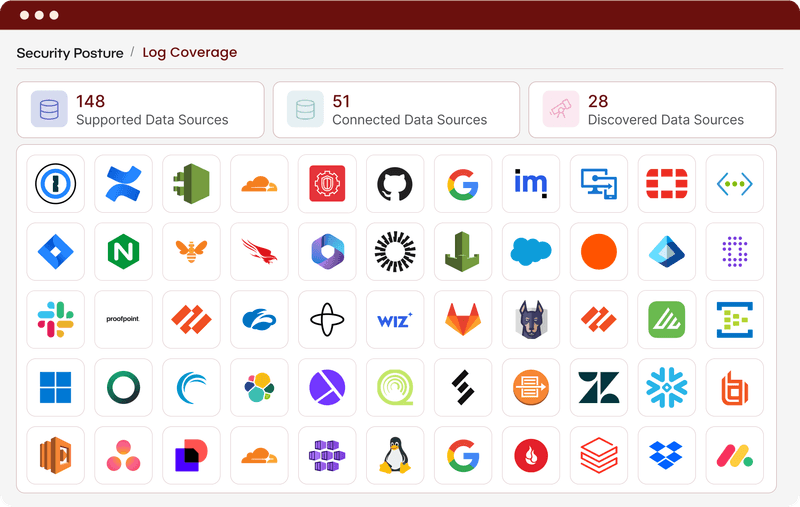
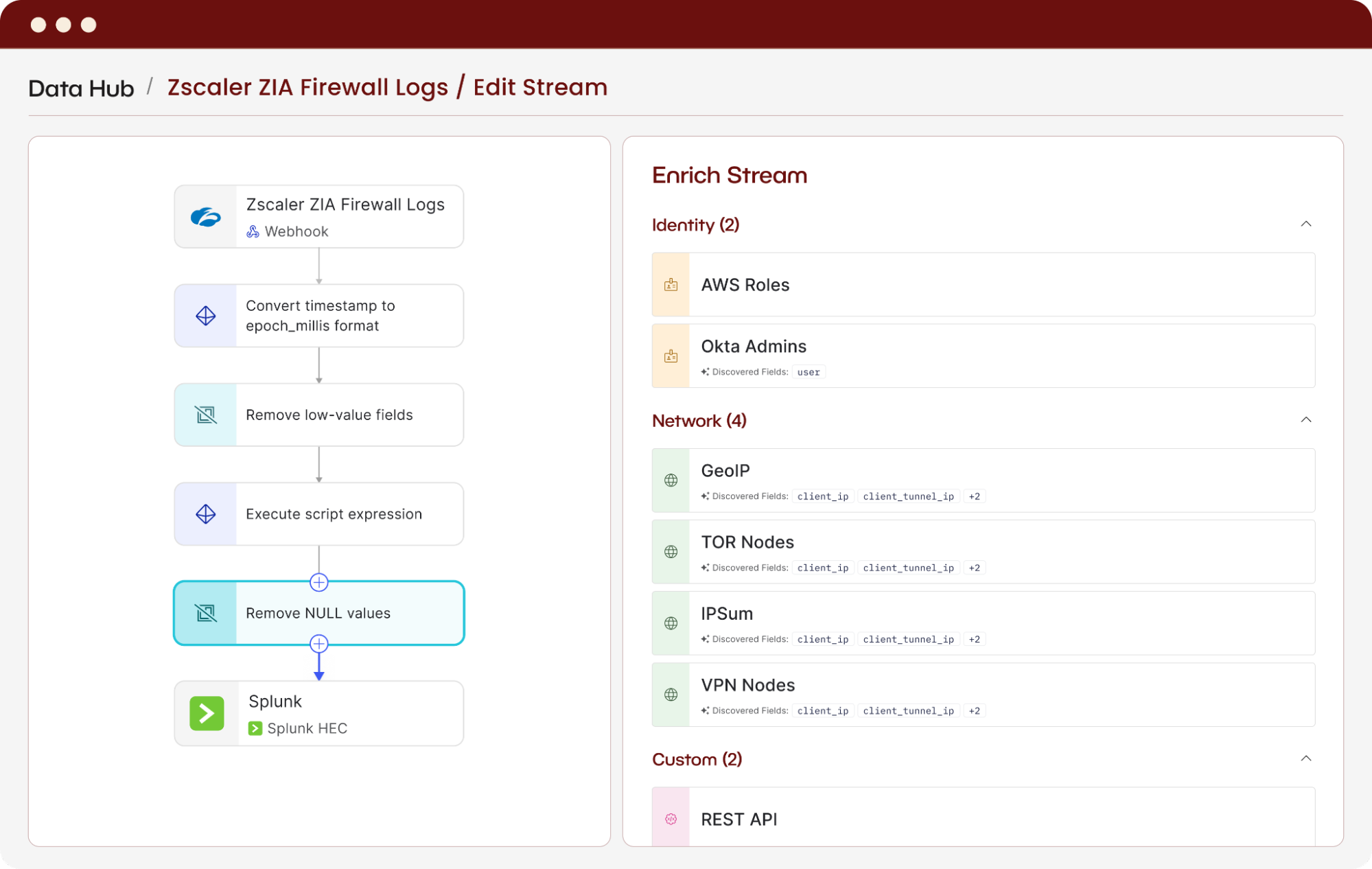
Beacon natively supports hundreds of connectors with pre-built mappings, and generates new mappings quickly when a source isn't covered, turning blind spots into detection and investigation surface.

Beacon normalizes once and routes to every destination in the format it expects: SIEM, data lake, warehouse, or cloud storage. No re-transformation needed when migrating SIEMs or adding new tools.

Vendors change their log formats, add fields, deprecate others. When that happens, detections break, often without anyone noticing. Beacon detects schema drift and adapts mappings so normalization stays accurate as sources evolve.
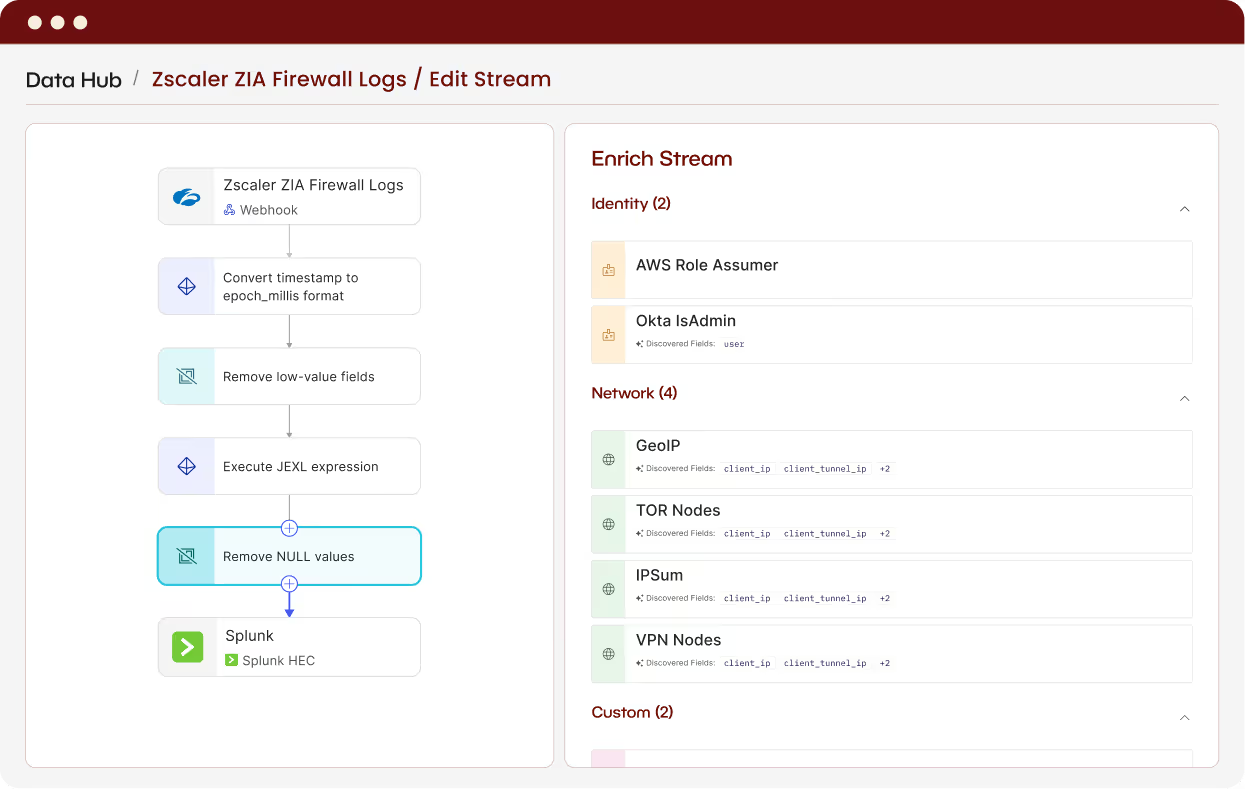
With most pipeline tools, normalization is a DIY project. Beacon ships with pre-built, expert-validated mappings for hundreds of sources across ECS, OCSF, ASIM, CIM and other schemas. New sources onboard in minutes, not weeks.

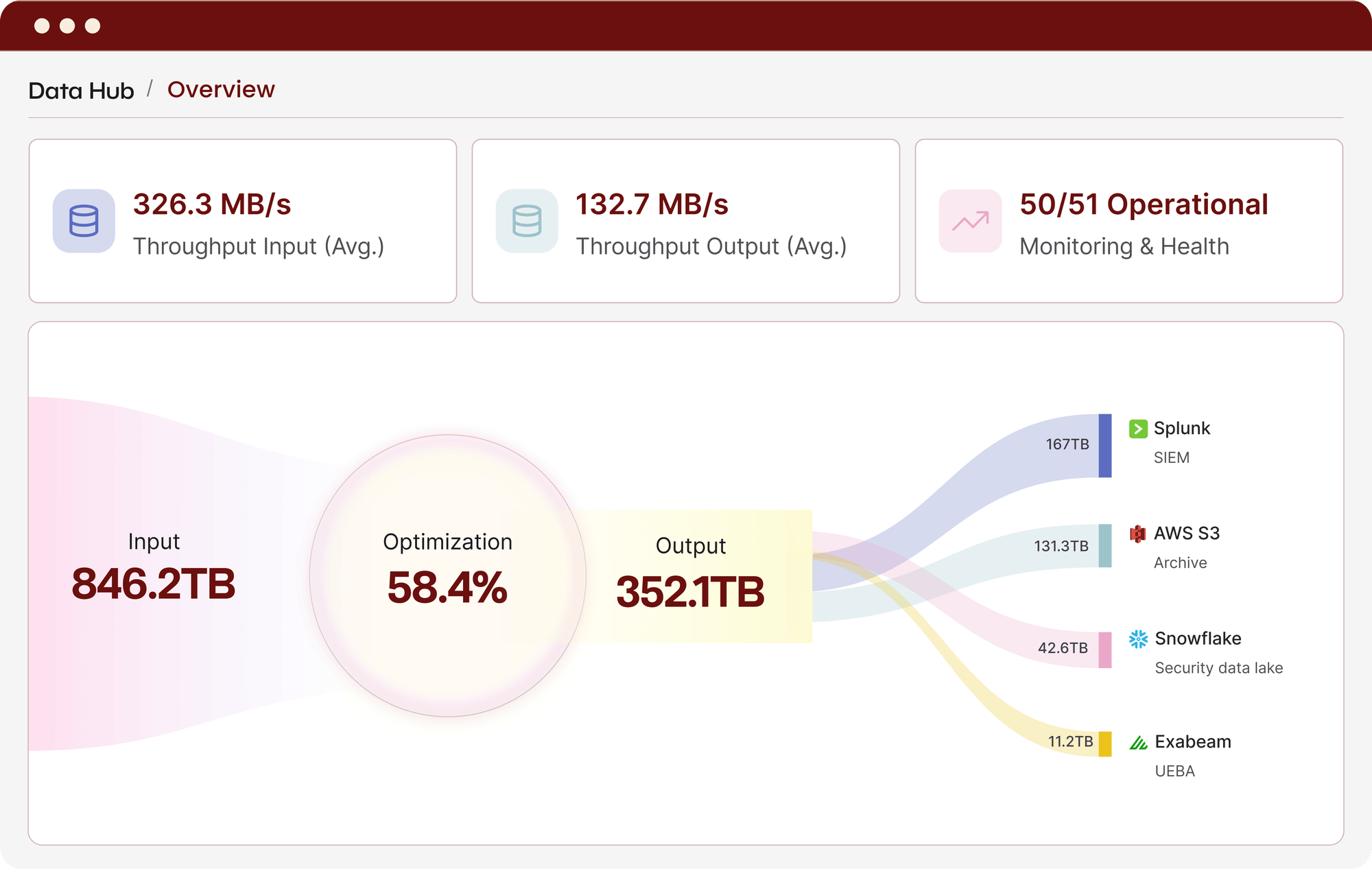
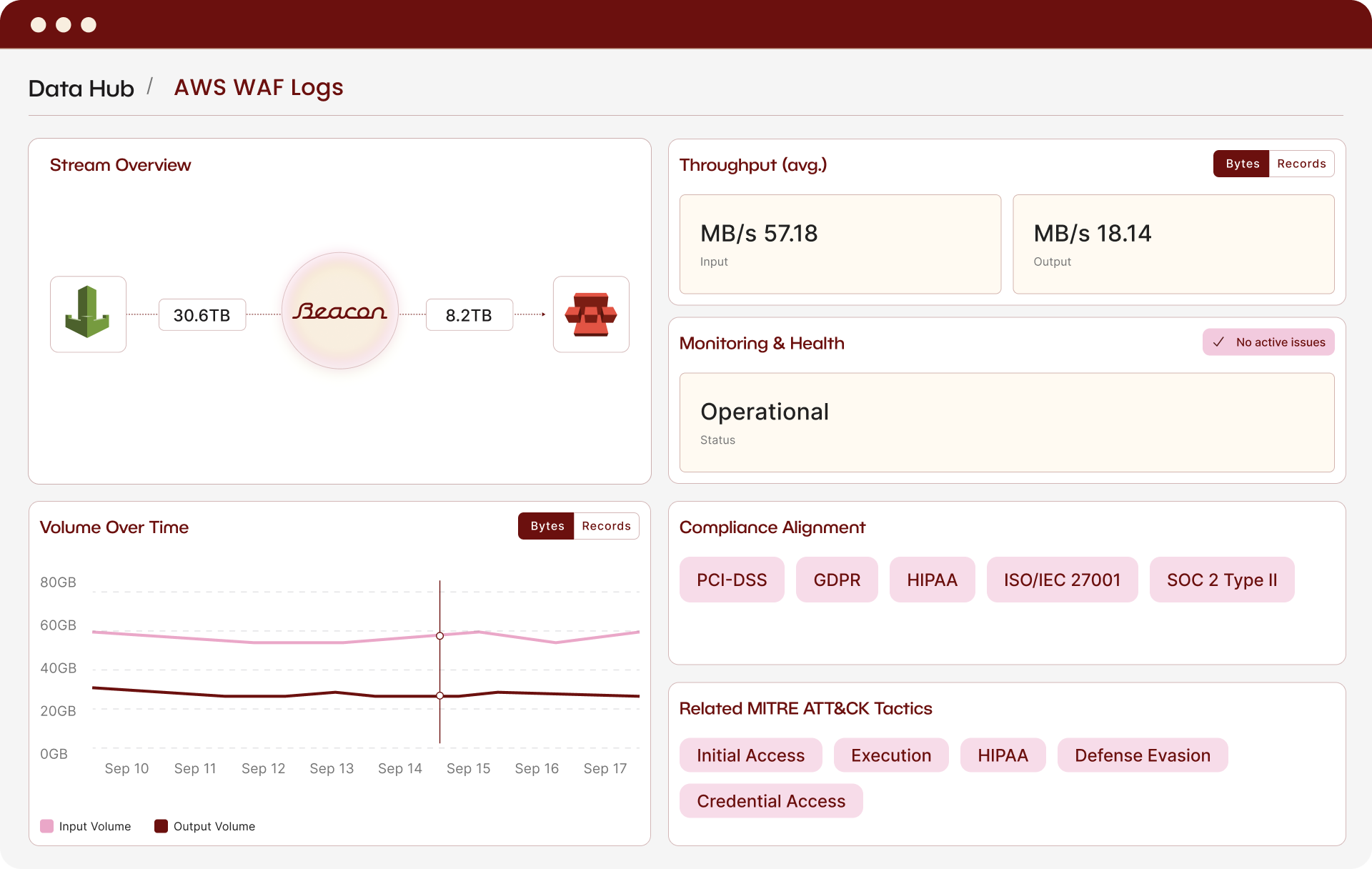
Beacon's security-driven data platform optimizes terabytes of important security logs spanning many sources. Data arrives enriched and normalized, and in the case of bloated VPC flow logs, reduced to 5% of their original size, enabling our security team and AI workflows to act immediately and effectively. We no longer choose between coverage and cost efficiency. We now have both, supported by a responsive team of security data experts.
Frequently Asked Questions
Schema normalization is the process of transforming raw, source-specific logs into a consistent structure (such as ECS, OCSF, ASIM, or a custom schema) so detections, queries, and investigations work reliably across all data sources. It ensures that tools receive data in the exact format they expect.
Most SIEM content (detections, correlations, dashboards) assumes logs follow a specific schema. When new or unsupported sources don’t match that structure, rules fail silently or require custom rewrites. Beacon ensures incoming telemetry is mapped to the schemas your SIEM expects, so detection logic works consistently without constant maintenance.
No. Beacon preserves all fields required for detections and investigations while aligning them to the correct schema. Normalization improves reliability by ensuring rules, correlations, and queries run as designed, even when log formats change.
Beacon supports industry-standard schemas such as ECS, OCSF, and ASIM, as well as SIEM-specific native schemas and fully custom formats. Teams can standardize data once and deliver it in the structure each tool expects, without rebuilding pipelines.
No. Beacon adapts to schema changes upstream, preserving the structure your SIEM and detection logic expect.
No. Beacon performs normalization in-stream as part of its unified data pipeline. Structured, schema-aligned data arrives ready for detection without slowing ingestion or requiring post-processing
Absolutely. Many SIEMs lack native support for long-tail SaaS, cloud, or internal systems. Beacon maps unsupported sources into your existing schema, allowing you to apply existing detection content without building custom parsers.
No. Beacon normalizes diverse log formats into a consistent schema upstream, eliminating the need to manage and maintain source-specific parsers inside your SIEM.